A name that tells you almost nothing true
Shropshire Blue was not born in Shropshire. The cheese was developed in the 1970s near Inverness, in the Scottish Highlands, and has since migrated entirely to Nottinghamshire and Leicestershire — the same stretch of England that produces Stilton. The name was a piece of marketing. Something about it sounded right: solid, regional, implicitly trustworthy. The cheese itself turned out to be genuinely good, which is why it has lasted.
Names get chosen for their ring, their market appeal, or their association with a product that already commands respect. What makes Shropshire Blue worth understanding is that once you get past the label, it has a character entirely its own.
The orange that isn't cheddar
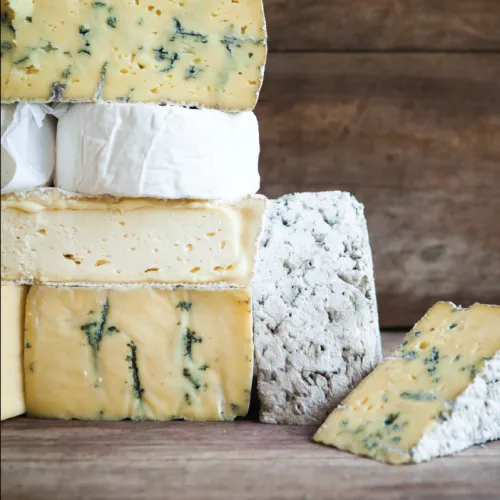
The first thing most people notice is the colour. Shropshire Blue is strikingly orange — not the pale ivory of Stilton, not the waxy yellow of a cloth-bound territorial. The colour comes from annatto, a natural dye extracted from the seeds of the achiote tree, which we cover in our separate piece on annatto in British cheese. Against that warm orange backdrop, the blue-green veining runs in the same branching patterns you'd find in any hand-pierced blue, but the visual contrast is considerably more dramatic.
Annatto has no significant effect on flavour — it is essentially inert as a taste compound — so the orange is purely aesthetic, a deliberate choice to make this cheese immediately recognisable on the shelf. The effect has stuck.
How it sits alongside Stilton
Made in the same dairies and by broadly the same method as Stilton — full-fat pasteurised milk, hand-ladled into moulds, pierced to encourage the veins — Shropshire Blue is nonetheless a different eating experience. It tends to be softer in texture and noticeably sharper in flavour. Where Stilton at its best has a deep, savoury, almost mushroomy quality that builds slowly, Shropshire Blue is more immediate: tangier, with a brightness that sits towards the front of the palate rather than developing in the finish.
That sharpness makes it easier to read on first bite, perhaps less complex over time. It pairs well with anything that can meet its acidity without being overwhelmed: oatcakes, a ripe pear, something with a little sweetness or crunch. Our piece on Britain's blue cheeses sets it in the wider context of the category.
Because it shares so much of the same infrastructure and technique as Stilton, Shropshire Blue sits comfortably alongside it on any board — the colour contrast alone makes it worth including. But it is not trying to be a tinted Stilton. The sharper profile means it holds its own.
What the name tells us about cheese marketing
There is something instructive about a cheese invented in Inverness, now made in the East Midlands, named after a county in the West Midlands. Shropshire, as a name, carries pastoral weight — hills, tradition, old farming country. None of that is specifically relevant here, but British cheese has a long history of this kind of nominal shorthand. Buyers respond to place names that sound grounded, even when the connection is loose.
Shropshire Blue has outlasted the slight awkwardness of its origin story because the cheese is good enough to stand on its own terms. It has never sought protected designation in the way that Stilton has — there are no geographical restrictions governing where Shropshire Blue can be made or who can make it. That absence of a PDO is either a commercial vulnerability or a freedom, depending on how you look at it. For now, production remains concentrated in the same Midlands dairies that make Stilton, which keeps a degree of consistency in the cheese even without formal protection.
Finding and serving it
Shropshire Blue is widely available through cheesemongers and many supermarkets, usually sold in wedges cut from the whole truckle. Look for a paste that is moist and giving rather than dry or crumbly at the edges — a dried-out cheese will have lost much of its defining tang. The rind should be firm and slightly powdery.
Serve it at room temperature. Straight from the refrigerator, the sharpness can feel flat and the texture chalky. Given time to relax, the orange and blue is as striking on a plate as it is in the display cabinet — a reminder that however the name came about, the cheese has always been the point.