A blue unlike any other on the shelf
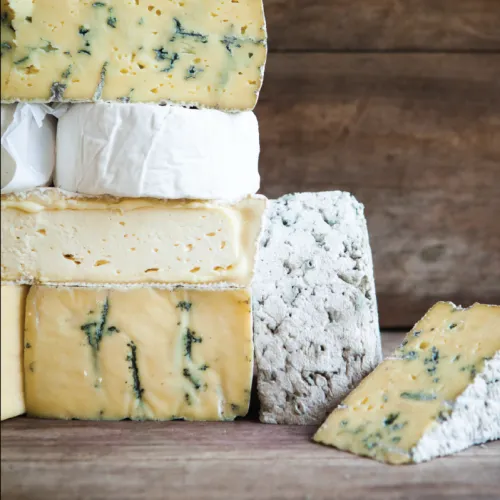
Pick up a wedge of Buxton Blue and the first thing you notice has nothing to do with the mould. The paste is a deep, burnished russet-gold — not the ivory-cream you expect from a blue, and not the orange rind of a washed cheese. The colour comes from annatto, the natural seed-derived pigment that cheesemakers in this part of England have long used to mark out particular styles. Our annatto piece covers that tradition and how the colouring works. Set against the russet paste, the blue-green veining looks almost dramatic.
The flavour, though, is far quieter than the appearance suggests. Buxton Blue is noticeably milder than Stilton, with a nuttiness that comes through cleanly rather than the assertive, almost mineral punch that puts some people off bolder blues. The texture is firmer and more close-knit too — it slices rather than crumbles, which matters on a board where portions need to hold their shape.
What the PDO actually means
Buxton Blue carries Protected Designation of Origin status, worth understanding properly rather than treating as a badge on the packaging. PDO is the most geographically specific of the European-origin food protections now maintained in UK law. It means the cheese must be made, processed, and prepared in a defined area — here, the Peak District and the broader east Midlands region historically associated with this style — using methods that meet the registered specification.
The practical consequence for the shopper is straightforward: the name cannot legally be used by a lookalike made in Somerset or Scotland or anywhere else, even if the maker follows the same recipe. With a cheese as obscure as Buxton Blue, that matters — without protected status there would be little stopping a larger producer from borrowing the name and attaching it to something made at scale elsewhere.
PDO does not tell you which specific farm or dairy made the cheese, and it does not guarantee that every batch will taste identical — cheesemakers are still craftspeople working with a living product. But it anchors the cheese to a place and a practice in a way that a purely commercial brand name cannot.
Stilton's quieter neighbour
Buxton Blue and Stilton share geography — broadly the same stretch of the Midlands and Peak District that has produced pastured-milk cheeses for generations. The family resemblance is real: both are blue, both carry PDO protection, both appear on Christmas cheeseboard lists. But where Stilton has become one of the most recognised British cheeses internationally, Buxton Blue remains largely unknown outside serious cheese circles.
That obscurity is partly structural. Only a small number of dairies produce it, and distribution is limited — most mainstream cheese counters never carry it. You are more likely to find it at a specialist cheesemonger, a good farmers' market, or ordered directly from a producer. That restricted supply is also, in a way, part of what keeps it interesting: this is a cheese that still requires a little effort to find.
Our British blues piece covers the wider landscape of lesser-known protected blues, of which Buxton Blue is one of the most distinct — worth reading alongside this if the category is new to you.
How to eat it
Because the texture holds together well, Buxton Blue works on a board in a way that softer blues sometimes do not — you can cut a clean slice rather than spreading or spooning. The milder flavour pairs comfortably with sweeter accompaniments, particularly fruit cheeses and darker honeys, without the blue being overwhelmed. It also sits well alongside something with a little residual sweetness: a good perry, a tawny port, or an off-dry British cider all complement the nuttiness of the paste.
If you are new to blue cheeses, or buying for someone who finds Stilton too assertive, Buxton Blue offers real character and a proper provenance story without the intensity that makes bolder blues an acquired taste.