What cold does to cheese
Refrigeration is a necessary evil for cheese. It slows the bacteria and moulds that would otherwise run riot, but it also suppresses the microbial activity that gives each cheese its character. Fat, which carries much of the flavour, stiffens in the cold. Volatile aromatic compounds — the ones that make a washed-rind cheese pungent, or a good Cheddar nutty and complex — are far less active at low temperatures. The result is a muted, flat version of what the cheese could be.
This is not subtle. Taste a slice of a well-made hard cheese straight from the fridge, then taste it again after an hour at room temperature. The texture loosens, the smell opens up, and flavours that were barely perceptible become insistent. You have not changed the cheese; you have simply allowed it to speak.
Which cheeses suffer most
Fresh cheeses — ricotta, young goats' cheeses, fromage frais — lose less because their flavour profile is simpler and more lactic to begin with, though even these benefit from a short rest.
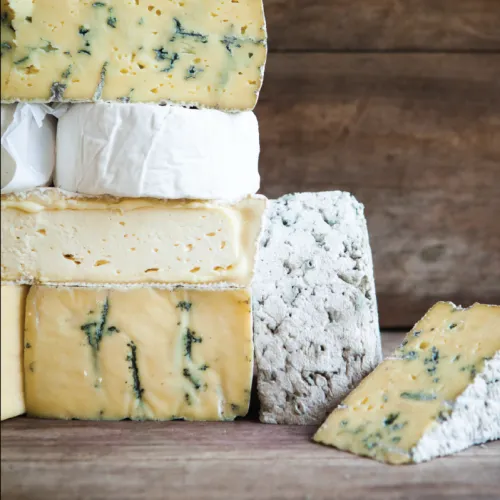
The cheeses hit hardest are those with the most going on. Aged hard cheeses such as a mature Cheddar or a well-kept Pecorino develop crystalline tyrosine deposits and complex savoury depth over months. That depth is largely inaccessible when the cheese is cold — what you taste is little more than salt and a vague sharpness. Blue cheeses are similarly affected: the fat that carries their peppery, mineral quality turns waxy and dense straight from the fridge, and the veining tends to taste metallic rather than rounded.
Washed-rind and soft-ripened cheeses — Brie, Camembert, Époisses and their kin — represent the most extreme case. They are designed to be almost runny at the centre, with an aroma that fills the room. Cold stops all of that. A Camembert served from the fridge is a different food from one that has sat out long enough to yield to gentle pressure.
How to bring cheese to temperature properly
An hour before serving is the most commonly given guidance, and it holds up well for most situations. For a thick wedge of aged hard cheese in a cool kitchen, a little longer does no harm. For a very ripe soft cheese in a warm room, keep an eye on it.
Keep the cheese wrapped while it warms. Unwrapping it immediately exposes the cut surface to air, which begins to dry it out. Leave it in its original wrapping, or cover loosely with the waxed paper or cloth it came in, and only unwrap shortly before serving. The rind of a whole cheese protects it naturally; it is the exposed paste that needs attention.
Avoid anything that accelerates warming artificially. Placing cheese near an oven, a radiator or in direct sunlight creates uneven warming — the outside softens and may begin to sweat while the interior stays cold. Slow warming at room temperature is what you want.
Thinking about the board as a whole
If you are serving several cheeses together, a selection spanning fresh, aged and blue styles can all come out at the same time — but a very ripe Brie will be ready sooner than a dense, wax-coated territorial. Arrange the board so guests can see which is which; if the soft cheese is lagging, unwrap it a few minutes ahead of the harder ones.
The board itself matters. A cold slate or marble surface pulled from a cool room will draw warmth away from the cheese. A wooden board at room temperature is more forgiving, and most artisan cheesemakers regard wood as the natural companion for cheese anyway.
Small details compound. A good piece of cheese brought to the right temperature can be undone by a fridge-cold chutney dolloped alongside it. Temperature is part of the whole picture.
A note on cutting
Aged hard cheeses can be crumbly at the best of times, but cold makes them brittle in a less pleasant way; a cold blue tends to drag and smear rather than cut cleanly. If you are preparing a board in advance, cut what needs cutting after the cheese has had time to warm slightly. The texture will be more cooperative and you will get a cleaner result.