The meat percentage, decoded
Every British sausage pack must declare its meat content as a percentage, and this figure tends to dominate how people choose between products. More seems better. In practice, it's more complicated.
The percentage covers what the law counts as meat — which includes fat naturally attached to the muscle. A sausage declaring 80% pork could, depending on the cut used, contain a significant proportion of that as fat. The remaining 20% is rusk, water, added fat, seasoning, and usually a preservative. None of that makes it a poor sausage. Rusk absorbs the cooking juices and fat released during frying, keeping the sausage moist rather than letting it shrink into a dry tube. A sausage made to 97% pork with nothing to do that job can be dense and mealy — far less enjoyable than one made by a careful butcher at a more moderate percentage. The craft is in the balance, not the headline number.
The rest of the label matters more
The ingredients list tells a more useful story than the meat percentage alone. A short list — pork, rusk, water, seasoning, a single preservative — generally signals a more straightforward product than one running to a dozen additives. Whether the pork is named by breed or farm matters too: a pack specifying a particular breed is making a claim about flavour and traceability that a generic 'British pork' declaration does not.
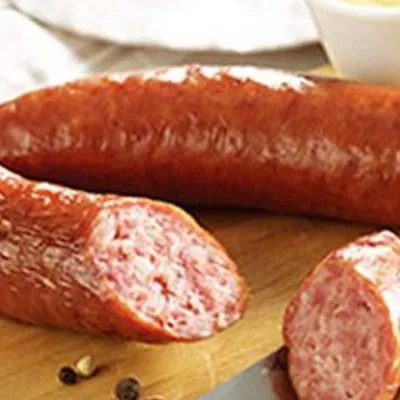
Casings are worth checking. Natural casings, made from animal intestine, give a sausage its characteristic bite and blister attractively in the pan. Collagen casings — the extruded, uniform alternative — don't replicate that. The difference is noticeable at the table even if it's invisible on the shelf.
Preservatives appear on most commercial sausages, commonly as sodium nitrite or nitrate compounds. The label tells you whether they are present and in what form. Some smaller producers, selling direct or through specialist butchers, avoid them — the trade-off being a shorter shelf life and a need to freeze promptly if you're not cooking within a day or two.
Cumberland, Lincolnshire, and what the name guarantees
Not all sausage names are equal. Cumberland sausage and Lincolnshire sausage both carry Protected Geographical Indication status, meaning there are legal rules governing what can carry those names. Cumberland sausage — traditionally sold in a coil rather than links — must be made to a defined recipe with a high pork content and a pepper-forward seasoning. Lincolnshire has its own specification: a coarser texture and a seasoning profile built around sage.
These protections exist because both are genuinely regional products with established traditions, and the designation stops the names being used loosely on products that share only the geography — or nothing at all. When you buy a sausage labelled Cumberland or Lincolnshire from a producer entitled to use that designation, you are getting a product made to a defined standard. A sausage labelled 'Cumberland-style', by contrast, has no obligation to meet those rules.
A generic 'pork sausage' carries no regional specification and no seasoning requirements — which is not a criticism. Many excellent sausages operate outside any protected category, and regional butchers often have their own house blend that doesn't map onto any formal definition. The difference is simply that with a protected name, you know the specification before you buy.
How to choose
The most reliable approach is a short, legible ingredients list from a producer who names their source. A breed name signals a considered choice about flavour; a farm name signals traceability. Natural casings and a modest preservative declaration round out the picture.
None of this requires paying the highest price on the shelf — it requires reading past the meat percentage and taking the rest of the label seriously. A sausage with a named source, short ingredients, natural casing, and a sensible percentage is likely to reward you in the pan, whether it carries a protected designation or comes from a butcher who has been making the same recipe for decades with no formal status at all.