Start with the right conditions
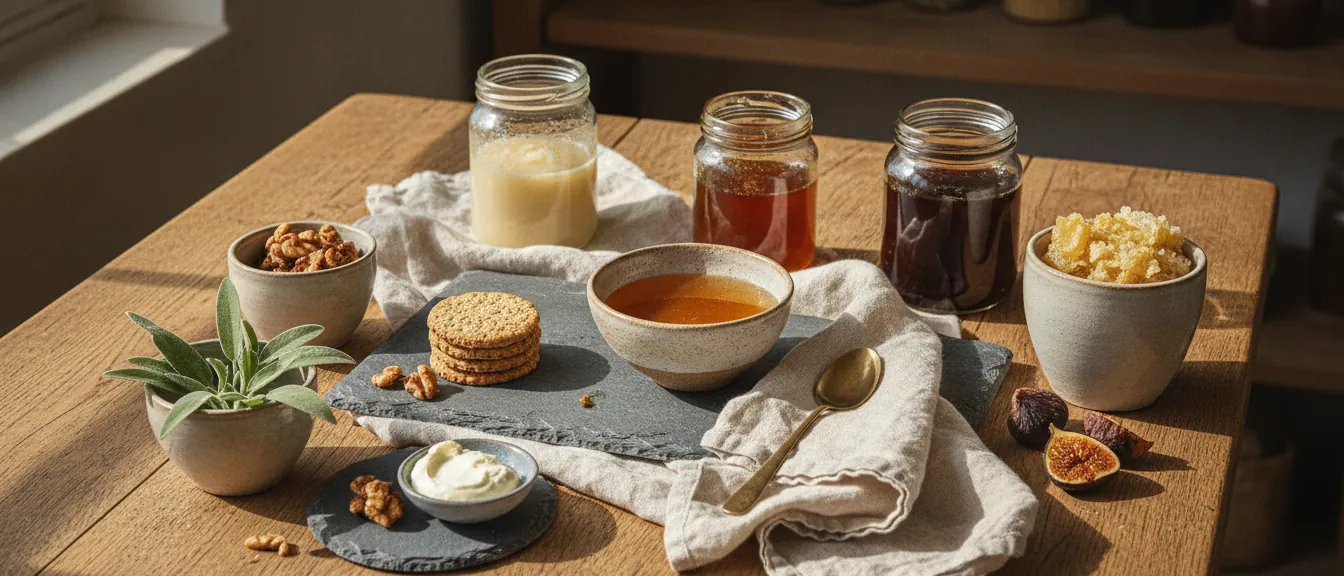
Temperature matters more than most people expect. Honey straight from the fridge is muted — its volatiles, the aromatic compounds that carry floral character, are suppressed by the cold. Give it time to come to room temperature before you begin. A small amount in a white ceramic dish or a plain glass jar lid is ideal; anything too flavoured or patterned will distract you.
Resist the urge to eat it immediately. Put a little on the back of a clean spoon, hold it close and breathe in. The aroma is where a great deal of the story lives, and most of us skip straight past it.
What you are actually looking for
Flavour in honey works in layers. The first impression — how it lands on the tip of the tongue — is usually sweetness, but that fades quickly into what tasters call the mid-palate: the floral, herbal or earthy notes that reveal the honey's source. Then comes the finish, which lingers at the back of the throat and can be clean and brief, or long and slightly tannic.
Try to resist reaching for the word "sweet" at all during a tasting. It is almost always there; it tells you very little. What you are looking for is what lies behind it. Is there something like warm beeswax? A faint grassiness? A sharpness, almost citric? Something darker — dried fruit, wood smoke, molasses? These distinctions are not invented by specialists to sound impressive. They are genuinely present in the honey, produced by the particular mix of nectars, pollen and enzyme activity involved in its making.
Texture carries meaning too. A runny, syrup-light honey and a thick, set honey made from the same source will taste subtly different, because the denser structure slows how flavour is released across the palate. Neither is better; they are just different things to pay attention to.
The classic contrast: heather against blossom
If you want one exercise that teaches you more than any description can, taste a British heather honey alongside a mild mixed blossom honey. These two represent the outer edges of what British honey can be, and the difference between them is extraordinary.
Blossom honey — gathered from a mixture of orchard and hedgerow flowers — tends to be gentle and approachable, with a clean sweetness and perhaps a light floral or slightly buttery quality. It sets to a pale, smooth cream. The finish is usually short.
Heather honey is a different proposition entirely. Ling heather, the dominant variety harvested from upland moors across Scotland, Wales and northern England, produces a honey with a pronounced, almost medicinal depth — peaty, resinous, slightly bitter on the finish. Its texture is thixotropic, meaning it is gel-like and resistant in the jar, but loosens when stirred; no other common British honey behaves this way. Tasting them together makes each one clearer. The blossom seems lighter than it did alone; the heather more complex, more demanding.
How to build the habit
Two or three honeys side by side is the most effective way to train your palate, and it does not need to be elaborate. Choosing honeys with genuinely different origins — a lowland blossom, a heather, perhaps a borage or a wildflower from a specific region — gives you enough contrast to be instructive without becoming overwhelming.
Take notes, even rough ones. Writing down what you find, however uncertain, forces you to commit to a description rather than letting the impression dissolve. Over time, patterns emerge: you start to recognise the particular waxy warmth of a well-kept comb honey, or the sharper brightness that often comes from honeys gathered near fruit blossom in early summer.
It is also worth tasting with something plain alongside — a piece of mild cheese, a water biscuit, a little unsalted butter on bread. These are not distractions; they show you how the honey changes in context, which is often where its character is most readable.
What the label can and cannot tell you
A single-origin or monofloral label means the beekeeper has placed hives where one plant source dominates, and that the resulting honey reflects that source clearly. But honey is never entirely monofloral in a strict botanical sense — bees forage widely, and weather, season and landscape all shape what ends up in the jar. The label is a useful guide, not a guarantee.
The most honest thing a label can tell you is provenance — where the bees foraged, and in what kind of landscape. A honey described simply as "British" offers little to go on. One described as from upland moorland, or from a particular vale or estuary, gives you something to taste towards. That specificity, when a producer offers it, is usually a sign they are paying close attention.