Start with your eyes
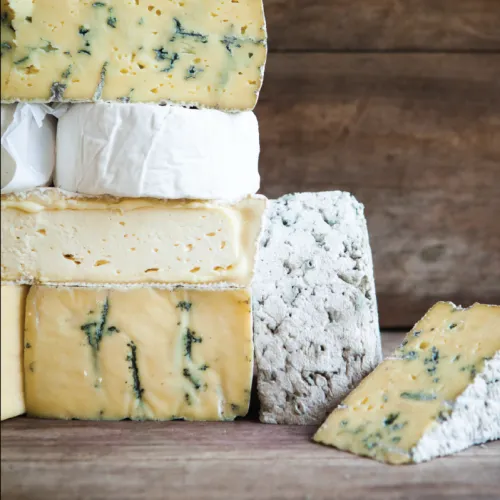
Before you lift a piece to your mouth, look at it. The colour of a rind tells you something about how a cheese was aged or treated — the dusty white bloom on a young goat's cheese, the orange-rubbed skin of a washed-rind, the natural grey-brown of a cloth-bound truckle. Paste colour matters too: a deep golden yellow suggests grass-rich milk; a chalky white core in a soft cheese shows it hasn't fully ripened to the centre. None of this requires expertise. You're simply registering what's in front of you before your other senses take over.
Smell before you taste
Aroma does most of the work in flavour perception, and cheese rewards a proper sniff. Hold the piece close and breathe in slowly. Some cheeses smell of fresh cream or warm milk. Others carry farmyard notes, mushroomy earthiness, roasted nuts, or something sharper — ammonia in an overripe soft cheese is a warning sign rather than a feature. Don't feel obliged to name what you notice in professional terms. If it smells like a wet field or a buttered crumpet, that's a perfectly good description. Register the aroma before taste crowds it out.
Texture is part of the flavour
Take a small piece and let it sit on your tongue before chewing. Is it crumbly and dry, or supple and yielding? Does it melt quickly or resist? Aged hard cheeses often contain tiny crystals — pockets of amino acids that form during long maturation. That slight crunch is a sign of age, not a flaw. Softer cheeses tend to coat the mouth more fully, which affects how long the flavour lingers. Paying attention to texture slows you down in a useful way: it stops you gulping and gives the taste time to develop.
Work from mild to strong
If you're tasting several cheeses, order matters. Begin with the mildest — a fresh chèvre, a young Wensleydale, a mild Lancashire — and move towards the more assertive: aged territorials, blues, strong washed-rinds. Going bold to delicate means earlier cheeses will overwhelm later ones, and you'll lose the nuance in anything subtle.
Between each cheese, reset your palate. A slice of plain apple works well — its acidity clears residual fat from the mouth without contributing its own strong flavour. Plain water does the same job more neutrally. Bread is fine as punctuation between very different styles, but it fills you up and has its own flavour. Avoid anything strongly flavoured between cheeses.
What to notice, and how to say it
Track a few broad dimensions: saltiness, acidity, richness, bitterness, sweetness. Then there's the finish — what the cheese leaves behind after you've swallowed. A long finish, where flavour keeps developing for several seconds, is generally a mark of quality. A short, clean finish is no failing in a mild fresh cheese, but in something aged and complex, a flavour that vanishes immediately suggests the cheese hasn't been kept well.
Specialist vocabulary isn't needed. Useful language is concrete and comparative: sharper than the last one, tastes of salted butter, reminds me of tinned mushrooms, leaves a prickle at the back of the throat. What you're building, cheese by cheese, is a personal reference library. Taste an artisan cheddar alongside a supermarket block and you'll understand the difference immediately — using words already in your head, not borrowed from a tasting guide.
One further point: the rind is edible on most artisan cheeses, though the waxy coating on some industrial cheeses is not. Tasting the rind alongside the paste gives a fuller picture — the rind on a Brie de Meaux carries quite different flavour compounds from the interior, and trying both together changes the experience considerably. You can always decide it isn't to your taste, but it's worth the experiment.
The goal isn't to sound authoritative at a dinner table. It's to get more from what you're eating — to notice things you'd otherwise miss, and to remember what you've tried well enough to find it again.