Why opening changes everything
A whole, uncut salami is a fairly self-sufficient object. Its casing, salt, carefully managed acidity and months of drying all conspire to protect what's inside. The moment you cut into it, you expose fat and protein to light, air and the damp environment of a domestic fridge — none of which the maker planned for.
The two things most likely to ruin opened charcuterie are opposite but equally common mistakes: sealing it so tightly in cling film that moisture has nowhere to go, and leaving it so exposed that it dries to a hard rind or — in the case of thin-sliced meat — goes leathery within a day. Getting the balance right is less about strict rules than understanding what the product actually is.
The whole piece versus the sliced question
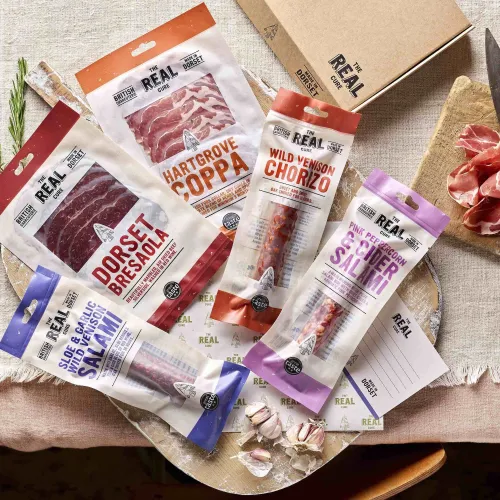
A whole salami that you're working through gradually is in a much stronger position than a packet of pre-sliced charcuterie. Surface area is the variable that matters: the more of it exposed, the faster fat oxidises, moisture migrates and flavour degrades. Pre-sliced bresaola or coppa has an enormous amount of exposed surface relative to its mass, which is why quality drops noticeably within a couple of days of opening. A whole piece with just one cut face has almost none.
For a whole salami — especially the dry, firm, hanging kind — refrigeration may not even be desirable if you're eating it reasonably quickly. A cool, dry, well-ventilated spot is closer to its natural curing environment than a cold, humid fridge. If the salami came hanging in a deli, that's a reasonable guide to what it prefers.
If you do refrigerate a whole piece, wrap the cut face loosely in greaseproof or butcher's paper, not cling film. The paper protects the exposed surface without trapping condensation against it. A loose outer layer of foil can keep the paper in place without creating a seal. What you want to avoid is a tight, airtight plastic wrap that makes the surface sweat.
White bloom and what to do about it
A powdery white coating on the outside of a salami is almost certainly nothing to worry about. That bloom is typically a naturally occurring mould — Penicillium species, usually — that curers have cultivated for centuries because it regulates moisture loss and contributes to flavour. It develops during the curing and ageing process, not as a sign of deterioration. Our article on salami mould covers this in more detail, and is worth reading if the subject is new to you.
Green, fuzzy, or patchy mould on a cut face or on sliced meat is a different matter. That's unwanted growth encouraged by excess moisture and poor air circulation; discard the affected product rather than cutting around it.
Fat, light and rancidity
Fat is not neutral. Exposed to air and light, the unsaturated fats in cured meat undergo oxidation — a chemical change that produces the stale, slightly soapy taste most people recognise as rancid. It happens slowly in a cool, dark fridge and much faster at room temperature in direct light. Leaving a board of sliced charcuterie in a sunny spot is a reliable way to ruin it; a clear bag near the back of a well-lit fridge is considerably better than storing it in the door.
For sliced charcuterie, eat it within a few days of opening, keep it in paper rather than film, and don't leave it sitting out longer than necessary before serving.
Serving temperature
Cold fat is dense and waxy — it coats the palate rather than melting on it, which mutes the flavours the maker worked to develop. Taking salami or whole-muscle charcuterie out of the fridge and allowing it to come up to room temperature before serving makes a striking difference. Even fifteen or twenty minutes helps.
This matters particularly for anything with a high fat content, such as nduja or a marbled lardo, and for anything that has been stored colder than ideal. The charcuterie articles on this site cover the broader context of how these products are made and what that means for how they're best eaten.