Start by tasting
Any cheesemonger worth their salt will let you try before you buy. This is how the trade works, and how you avoid taking home a blue that's sharper than you wanted or a washed rind more pungent than the occasion calls for. Don't be shy about asking for a sliver of the cheddar alongside the one you think you want — the difference between two farmhouse cheddars from different dairies can be striking, even when the labels look similar.
Tasting gives the cheesemonger something to work with. Tell them what you liked and what felt slightly off, and they'll narrow things down quickly. It's a conversation, not a transaction.
Tell them the occasion and who is eating
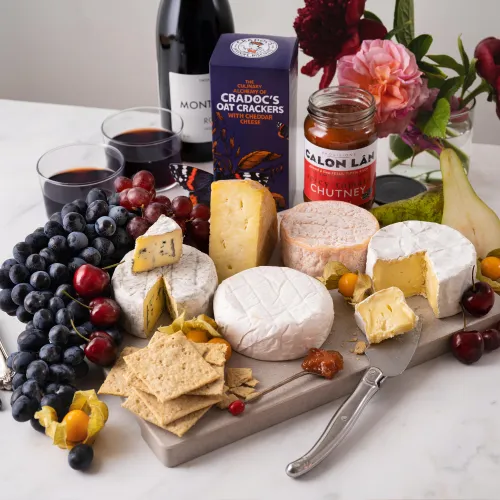
Before you point at anything in the cabinet, explain the context. A board for six adults after a dinner party calls for something different from a piece to eat with lunch across the week. If you're building a board, say so — a cheesemonger will think in terms of contrast: something firm and savoury alongside something soft, a blue to cut through the richness of a washed rind.
Mentioning who is eating matters too. A crowd that mostly eats supermarket cheddar needs a gentler introduction than a table of people who already seek out raw-milk cheeses. A good cheesemonger will pitch their suggestions accordingly, not talk down to you or push the most expensive thing on the counter.
Buy cut to order, in the amount you need
Pre-wrapped wedges are convenient, but they're not usually the best option in an independent shop. Ask for your cheese to be cut to order — you can specify exactly how much you need, which matters with a rich, assertive cheese you'll only use in small amounts. A 150g wedge of a powerful blue goes much further than the same weight of a mild fresh cheese, and buying precisely what you need avoids waste.
As our portions guide covers, it's easy to overbuy when choosing something unfamiliar. Asking for a smaller piece than you think you need is sensible — you can always go back.
Ask what's in best condition this week
Seasonal ripeness matters with cheese. A soft washed-rind that was slightly underripe last week may be at its peak today. A cheddar ageing in the cool room might have just developed its characteristic crystalline crunch. Cheesemongers pay close attention to this; ask what they're most excited about right now and you'll often be pointed towards something you wouldn't have noticed on your own.
The question also signals that you're interested in cheese as a living thing rather than a commodity, which tends to prompt a more generous, more interesting response.
Ask about provenance and production
Independent cheesemongers typically know their suppliers well and welcome questions about where a cheese comes from and how it's made. Whether a cheddar uses raw or pasteurised milk, whether the rennet is traditional animal rennet or a vegetarian alternative, which specific farm or dairy produced it — these are all fair questions, and the answers matter for flavour as much as for principle. Raw-milk cheeses often carry a more complex, lactic depth; cheeses made with vegetarian rennet can differ subtly in texture as they age.
If you need this information for reasons beyond flavour — dietary requirements, for instance — the cheesemonger can point you to relevant detail, and the Food Standards Agency is the right place for any formal guidance.
Wrapping and storing what you bring home
How you wrap and store cheese affects how long it stays in good condition. Our wrapping and storage guides go into detail, but most cut cheeses need to breathe — airtight plastic creates the damp, airless environment that encourages off-flavours. A good cheesemonger will wrap your purchase in waxed or cheese paper; ask them to do so if they reach for cling film instead.
Store most hard and semi-hard cheeses in the bottom of the fridge, loosely wrapped. Soft cheeses and washed rinds are more fragile — buying them closer to when you need them is the simplest approach.