The enemy is steam, not temperature
Once a pie is cooked and begins to cool, the crust holds its structure because its water content was driven off during baking. Introduce steam — from a damp cloth, a lidded dish, or a microwave — and that process runs in reverse. The pastry reabsorbs the moisture, and what had been flaky and crisp becomes soft, pale and grey.
A microwave works by exciting water molecules inside the food, heating everything from the inside outward. For a suet pudding sealed in a basin, that is exactly what you want. For a hot water crust or a laminated puff top, it is close to fatal. The filling heats quickly; the pastry, containing less water, absorbs the steam the filling gives off. The result is a grey, soft crust over a filling that may still be cold at the centre.
An oven does something different. It surrounds the pie in dry, circulating heat, driving moisture out of the crust while warming the filling simultaneously. The two processes work together rather than against each other — and that is the whole argument for dry heat.
Why a chilled pie behaves better than a frozen one
Going straight from freezer to oven seems efficient, but the result suffers. A pie frozen solid means the outside of the pastry reaches temperature long before the filling at the centre does. The crust can overbake while the heart of the filling remains cold. Thawing a pie thoroughly in the fridge first means everything starts from roughly the same temperature. Heat travels more evenly, the filling warms through at a pace the pastry can keep up with, and there is far less risk of the outside drying out before the inside is ready.
The governing principle — applicable to all reheated food — is that the filling must reach piping hot all the way through, not merely warm at the edges. With a dense, deep pie, this takes longer than instinct suggests. Checking by pressing a skewer into the centre and holding it against your wrist for a couple of seconds is an old trick, and still a good one.
The pies that should stay cold
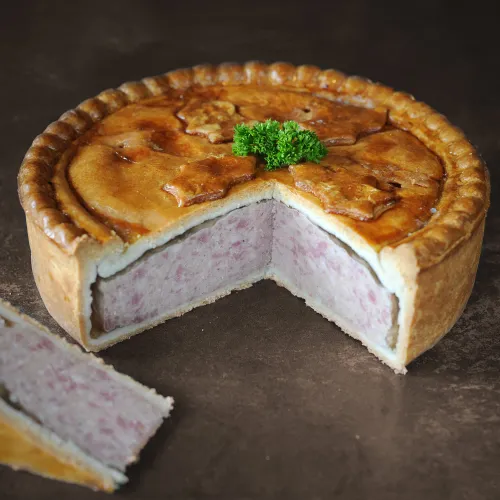
Not everything with a crust belongs in the oven. A raised pork pie — made with hot water crust pastry, packed with seasoned pork and set with a savoury jelly — is designed to be eaten cold. The jelly, which runs liquid when warm during potting and firms as the pie cools, is part of the whole point. Warming it melts the jelly back to liquid; it pools at the bottom of the crust, the structure becomes unstable, and the filling separates from the pastry walls. Our article on hot water crust pastry explains the technique behind these pies in detail.
Cold pork pie, cut thickly and eaten with proper mustard and dressed leaves, is not a compromise. It is the correct version. The same logic applies to most cold-set, jellied terrines and pressed meats in pastry — the chill is structural, not incidental.
What rewards gentle reheating
Shortcrust fruit pies and tarts can be revived in a low oven and are often better warm than at room temperature. Shortcrust handles reheating reasonably well because it is less laminated than puff and has fewer layers to separate and go leathery.
A sausage roll is enjoyable cold, and at its best fresh from the oven, but a brief blast of dry oven heat will crisp the outside back up the following day. The operative phrase is dry heat: uncovered, on a rack or tray, never wrapped in foil. Foil traps steam, replicating exactly what a microwave does.
Cornish pasties, Bedfordshire clangers, and similar hand-crimped pastries all reward the oven for the same reason. The thick crimped edge is the last part of any pasty to heat through. A microwave leaves it cool and doughy at precisely the point where it should be firm; an oven handles that edge properly.