Start with a rough weight per person
The figure that comes up most reliably among cheesemongers and seasoned hosts is somewhere between 70g and 100g per person when the board follows dinner. That is a rule of thumb, not a strict calculation — appetites vary, the richness of what came before matters, and a table of enthusiasts will always surprise you. Scale up if the cheeseboard is carrying the whole meal, or if you know your guests well enough to anticipate second helpings.
Think in terms of total weight first, then divide across your chosen cheeses. Feeding six people after supper, you are working with roughly 500–600g in total — enough to be generous without leaving half a truckle untouched.
Three to five cheeses, not ten
A board crowded with cheeses overwhelms rather than impresses, and smaller portions of each means nobody gets a proper taste of anything. Three cheeses is a perfectly respectable number; five is a considered spread. Beyond that, the differences blur and the board becomes harder to navigate.
Odd numbers work better visually, which is why three and five come up so often. An asymmetric arrangement looks more composed than an even row. Two cheeses can feel sparse; four often ends up looking like two pairs. Three sits naturally, five gives real variety without chaos.
The classic spread of styles
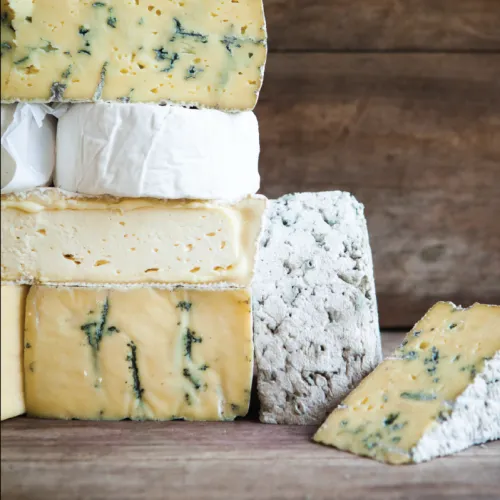
Variety across textures and intensities matters more than the exact cheeses you pick. A board built around a hard, a soft, a blue, a goat's and a washed-rind cheese covers the main families and gives guests something genuinely different in each piece.
The hard cheese — a well-aged Cheddar, a crumbly Lancashire, a Wensleydale — tends to anchor the board. It is familiar, pairs easily with almost anything else on the table, and reassures guests who find the more assertive styles a step too far. The soft cheese, a bloomy-rind Brie-style or something richer and unctuous, adds contrast in texture. Blue brings intensity; even a modest portion goes a long way. A fresh or semi-aged goat's cheese cuts through the richness of everything else with its clean acidity. The washed-rind — often the most polarising, sticky and pungent — rewards the adventurous and anchors the savoury end of the spread.
You do not need to tick every category. If blue cheese genuinely divides your table, leave it out and choose two styles you know will land. The principle is contrast, not completeness.
How to portion and serve
Bring cheese out of the fridge at least an hour before serving, longer if the room is cool. Cold cheese mutes flavour considerably; the difference between cheese straight from the fridge and cheese at room temperature is not subtle.
Cutting styles are practical rather than fussy. A hard cheese is easiest eaten in small, rustic pieces broken or cut across the grain. Serve a soft cheese whole or as a generous wedge so guests can take as much or as little of the rind as they like. Pre-cut blues into wedges rather than crumbling them — it looks more considered and lets people see what they are getting.
Label the cheeses if guests will not know them. It removes uncertainty and usually starts a conversation.
What to put alongside
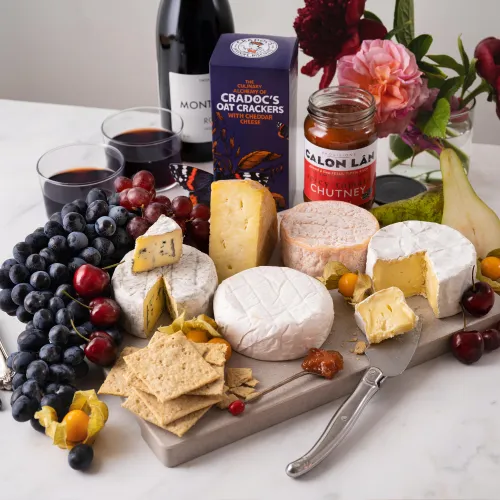
Accompaniments should support the cheese rather than compete with it. Plain crackers or good bread form the base — something without strong flavour of its own. Fruit such as fresh grapes, sliced pear or a few dried figs adds sweetness that works well against blues and aged hard cheeses. A decent chutney or two bridges savoury and sweet. Celery alongside blue is traditional for good reason: its freshness and mild bitterness genuinely help.
Keep the board uncluttered. If the accompaniments take up more space than the cheese, reassess.