Why blue reads strong
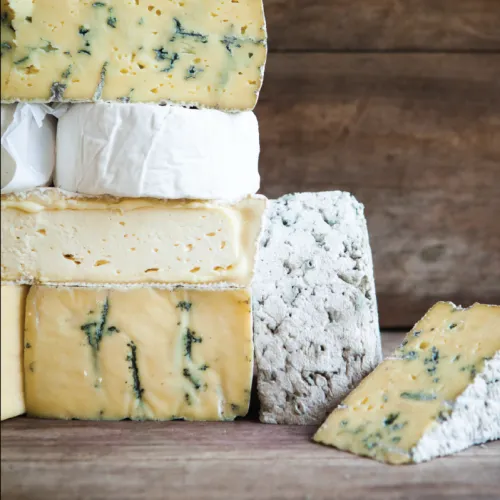
The flavour in a blue cheese is not spread evenly. Those blue-green veins – created when air channels allow a specific mould to grow through the paste – are where salt and piquancy concentrate most intensely. Eat a forkful that's mostly vein and you get the full blast. Eat the pale, barely-veined paste around it and you get something far gentler: milky, slightly tangy, not so different from a well-made soft cheese.
That uneven distribution explains the whole category. A young, softly-textured blue with minimal veining tastes completely different from a dense, crumbly, mature one where veining runs throughout. Same family, opposite ends of a long spectrum.
Start soft, start sweet
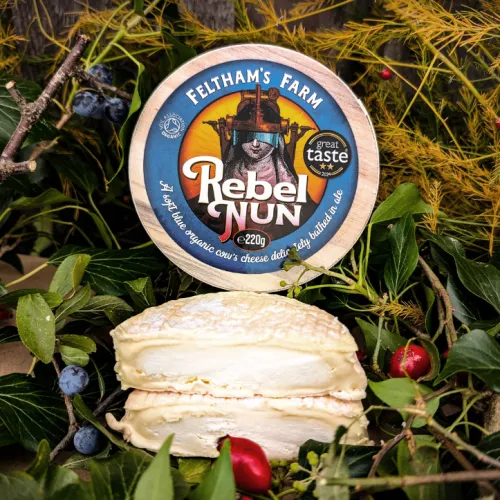
The gentlest route in is a young, creamy blue – paste almost spreadable, veins faint and sparse. The texture alone softens the impact; richness cushions any sharpness before it lands.
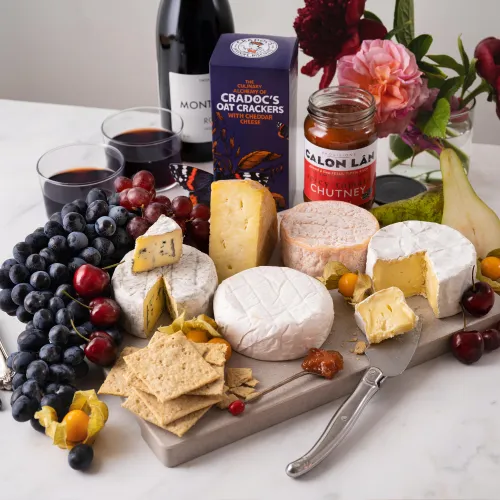
Pairing matters as much as the cheese itself. Sweetness counterbalances the salt-and-pique that puts most people off. A drizzle of good honey, a few slices of ripe pear, or a piece of fig – fresh or dried – doesn't hide the cheese; it makes the savoury depth more legible by setting it against something sweet. Blue and honey is a persistent British cheeseboard combination not out of laziness but flavour logic.
Buttery, mild blues sit on that same gentle rung. If the youngest, softest styles feel almost too mild, these are the obvious next step – still firmly in the mild half of the spectrum but with a little more character.
Building up gradually
Once a creamy blue feels comfortable, the path forward runs through texture rather than intensity. As blues age they become drier, denser, more crumbly – and more assertive. The salt sharpens, the piquancy deepens, complexity builds. A young creamy blue and a mature Stilton are categorically different experiences, but a logical progression connects them.
Stilton – covered in more detail in our British blues and Stilton articles – sits in the middle-to-upper range. Crumbly, complex, and decidedly blue in character, but eaten with oatcakes and a little fruit it remains manageable. The mistake is treating strongly crumbly, intensely aged blues as the entry point. They're the summit. Arriving there through the gentler styles is a different experience entirely from being handed one cold.
A useful exercise: buy two blues at once, one noticeably milder than the other, and taste them side by side. The contrast makes both more comprehensible – you can see and taste where you are on the spectrum.
The cooked route in
Heat does something useful to blue cheese: it loses its sharpness and becomes deep, savoury richness instead. Melted into a sauce or stirred through something warm and starchy, even a fairly assertive blue behaves quite differently from the same cheese eaten cold.
This is not a lesser way to eat it. Plenty of British cooking has used blue cheese this way for a long time. As a route to understanding the flavour, though, it works well – the same person who finds a wedge of blue challenging will often enjoy it without hesitation once it has been cooked in.
What to look for when buying
Ask whoever is selling for guidance on age and intensity – a good cheesemonger will usually let you taste before you commit, removing most of the guesswork. At a supermarket counter, look for descriptors such as mild, creamy, or young, and avoid anything marketed on its strength or age if you are still finding your footing.
- Pale paste with sparse veining: generally milder
- Dense, darker paste with heavy veining throughout: generally more assertive
- Soft and spreadable: younger and gentler; crumbly and dry: more mature and intense
Keep blue cheese wrapped in wax paper or foil rather than cling film, which can make it sweat and turn ammoniated. Bring it to room temperature before eating – cold blunts the flavour of most cheese, and blues need a little warmth to show what they can do.