What makes it a raised pie
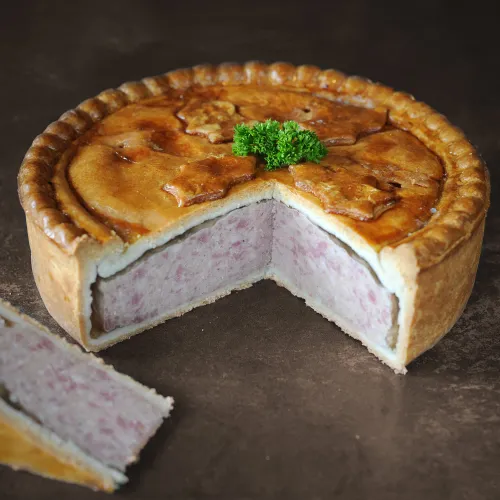
The defining feature is the pastry. Hot water crust — made by melting fat into boiling water and beating in flour — produces a dough that is workable, almost plastic, while warm. It can be moulded by hand around a wooden block (the traditional method, still used by skilled makers), or pressed into a hinged mould whose clip-apart sides release the pie cleanly once cooled. Either way, the crust must be thick enough to stand unsupported, because there is no tin left behind to prop it up at the table.
This is what separates a raised pie from an ordinary pastry case. The walls are structural. They hold the filling, absorb the juices, and carry the finished pie from counter to board without collapsing. Getting that balance right — firm enough to stand, not so dense that it becomes unpleasant to eat — is the central challenge of the form. The Melton Mowbray pork pie, covered in our article on that subject, is the benchmark of what hot water crust can achieve at its most refined.
Layering for the cut face
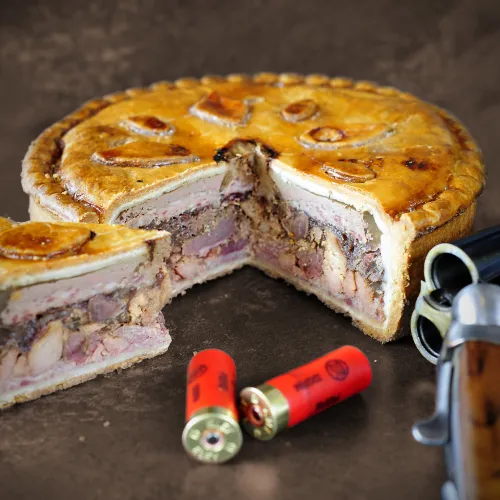
A game pie earns its reputation at the moment of slicing. The filling — which might combine pheasant breast, diced venison, boned rabbit, and a fattier base of seasoned pork — needs to be built in deliberate layers rather than mixed together. Each layer is pressed down firmly before the next goes in, removing air pockets and ensuring the filling knits together as it cooks.
A well-made game pie, sliced through the middle, should reveal distinct bands of meat: the dark, close grain of venison against paler pheasant, the pink of pork binding it all together. That cross-section is part of what the maker is presenting. A carelessly filled pie produces a muddled, crumbling face; a well-layered one holds cleanly and looks as considered as it tastes.
Pork plays a practical role as much as a flavour one. Game is lean, and lean meat alone produces a dry, dense filling. Fattier cuts of pork provide the fat that keeps the filling moist through a long bake and give the jelly something to bind to.
The vent hole and the jelly
Before the lid goes on, a hole is cut in the centre — sometimes two, in a larger pie. During baking, steam and juices need to escape; without a vent, pressure builds and the pastry can crack unpredictably. Some makers insert a small funnel of rolled foil or a proper pie funnel to keep the hole open through the bake.
After the pie comes out of the oven and begins to cool, the filling contracts and pulls away slightly from the crust, leaving gaps. A well-reduced, well-seasoned stock — made from the game carcasses, perhaps with a splash of port or Madeira — is allowed to cool until it reaches a loose, pourable consistency, then spooned carefully through the vent hole in stages. It finds the gaps in the filling and sets as the pie chills completely, becoming the translucent layer visible in a good cross-section. Without it, the sliced pie looks and feels hollow.
The quality of that jelly matters. A stock that has not been reduced far enough will not set firmly; one made without enough collagen — from bones and connective tissue — will not set at all. Makers who get this right tend to be proud of it, and with good reason.
Serving cold at the winter table
A raised game pie is almost always served cold, and this is by design rather than compromise. The flavours deepen as the pie rests, the jelly firms, and the pastry loses any residual sogginess from the filling. Chilling overnight is standard practice before slicing.
The traditional accompaniments are sharp, because the filling is rich. Pickled walnuts, onions, or red cabbage cut through the fat in the pastry and meat. Cumberland sauce — redcurrant jelly, port, and citrus — is the classic partner for game in this country; its sweet-acidic edge does the same work more elegantly. We cover Cumberland sauce in its own article for readers who want to understand that pairing further.
A raised game pie travels well, which is part of its historical appeal. It can be made several days ahead, needs no last-minute attention, and improves for the wait — which makes it genuinely useful at a Christmas or midwinter gathering.
_jpgq80.webp)