A straight sausage is a tell
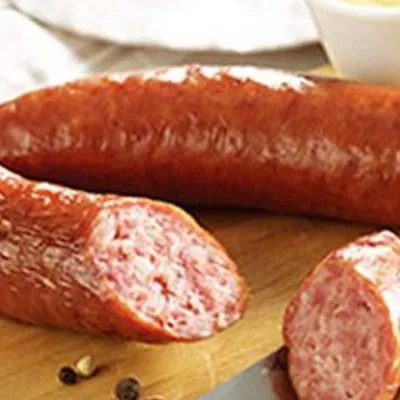
Look at a sausage before it goes in the pan. If it is perfectly straight and uniform in diameter, the casing almost certainly came off a machine rather than an animal. Natural casings — cleaned intestine, usually from hog or sheep — are narrower here, wider there, and they curve. That gentle bow in a good banger is the gut's original shape asserting itself. It is a small detail, but a reliable one.
Most shoppers do not know they are reading a signal. Craft butchers do. The choice of casing is one of the clearest dividing lines between sausages made carefully and sausages made cheaply at volume.
What natural casings actually are
Hog intestine is the standard for a full-sized British banger. Sheep intestine, thinner and more delicate, is the traditional choice for chipolatas — it gives that taut skin that blisters satisfyingly in a hot pan. The Cumberland's long coil depends entirely on hog casing; the continuous length is what makes coiling possible.
After slaughter, the casings are flushed, scraped and salted for preservation. Handled well, they are almost odourless and neutral in flavour. What they contribute is texture: that snap when you bite through a properly cooked sausage is the natural casing contracting under heat. It resists slightly, then gives cleanly. Collagen and plastic do not replicate this.
The other critical quality is permeability. Natural casing breathes. Smoke penetrates it, moisture escapes through it, and in air-dried sausages — a British salami, a cured chorizo made domestically — this is not a nice-to-have but a structural necessity. A sealed casing traps moisture and the process of slow drying stops working.
Collagen, cellulose and plastic
Collagen casings are made from processed cattle hide. They are consistent in diameter, strong enough for high-speed filling machines, and considerably cheaper at scale. For a supermarket sausage made in millions, that uniformity is the point. Collagen casings can be eaten, though the skin tends to be tougher and less responsive to heat than the natural article.
Cellulose and plastic casings belong to a different category. They are manufacturing aids, not edible skins, and you will find them on frankfurters, skinless sausages and some smoked products. The casing is stripped away after cooking or smoking — hence the smooth, seamless surface on a supermarket hot dog. There is nothing inherently wrong with this, but it signals something about the process: the casing is industrial infrastructure rather than part of the finished product.
Why this matters at the butcher's counter
Independent butchers who make their own sausages will almost always use natural casings, partly from tradition and partly because the results are better. The snap, the way the skin colours and chars at the edges, the ability to smoke or cure the sausage properly — these follow from using the right material. Many small producers argue that a natural casing holds the meat mixture more gently during filling, which helps maintain a looser, more open texture rather than the dense interior common in factory lines.
For smoked and cured products in particular, the casing is not interchangeable. A traditionally smoked sausage must absorb smoke over time, so the casing must allow it through. Producers making air-dried products that need weeks or months to mature work exclusively with natural casings because the biology of the original material is doing useful work.
None of this means collagen is fraudulent. It has legitimate uses and many decent sausages are made with it. But if you are buying from a craft butcher for the eating quality — the texture, the behaviour in the pan, the suitability for the barbecue or the curing chamber — natural casing is what you want, and knowing how to spot it is half the battle.